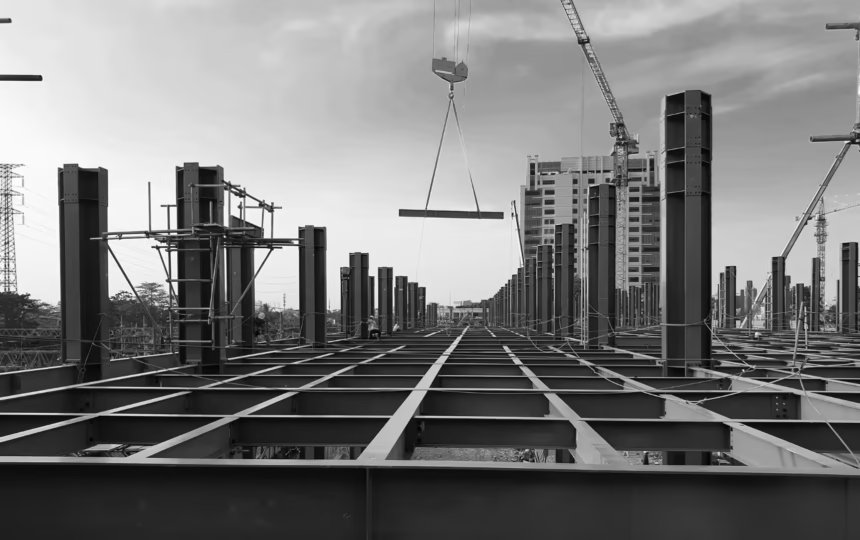
When you’re planning a construction project, whether it’s a home, a commercial building, or an industrial structure, the framing system is the decision that everything else is built around. It determines structural performance, maintenance requirements, and how long the building remains sound without significant intervention.
Steel framing has been gaining adoption in residential and commercial construction for decades, and the reasons are consistent across the experience of builders and building owners who have made the comparison.
Steel vs. Timber: The Durability Comparison That Matters
Timber has been the default framing material for residential and light commercial construction in many markets because it’s familiar, widely available, and relatively easy to work with. These are genuine advantages. But timber also has structural vulnerabilities that steel simply doesn’t share.
Moisture and biological degradation: Wood absorbs moisture. Over time, in environments with humidity cycling or moisture infiltration, timber framing can develop rot, mold, and structural weakening that requires costly remediation or replacement. Steel does not rot. It’s immune to mould growth and insect damage that can compromise timber framing without any visible external indication until significant damage has occurred.
Termite resistance: Termite damage is a major cause of structural failure in timber-framed buildings in termite-active regions. The remediation and rebuilding cost from significant termite damage can be enormous. Steel framing is not a food source for any biological organism, making termite risk a non-issue for steel-framed structures.
Dimensional stability: Timber expands and contracts with changes in moisture content and temperature. Over time, this movement contributes to cracking in plasterwork, sticking doors and windows, and subtle changes in structural alignment. Steel maintains its dimensions consistently, which means the building performs more predictably over its lifecycle.
Fire performance: Steel doesn’t combust. While it can lose structural strength at sustained high temperatures, it doesn’t add fuel to a fire the way timber does, which affects both fire spread and the aftermath of fire events.
Based on insights from the team at Steel Frames WA, the performance advantages of steel framing are particularly significant in the Western Australian climate, where heat, humidity cycling, and termite pressure create conditions that accelerate the vulnerabilities of timber framing.
The Structural Performance Advantage
Beyond material durability, steel framing delivers structural performance characteristics that affect both the building’s capacity and its long-term integrity.
Strength-to-weight ratio: Steel has an exceptionally high strength-to-weight ratio compared to timber. This allows structural spans that would require significantly larger timber members, contributing to design flexibility and the potential for open floor plans without compromising structural integrity.
Consistent structural properties: Timber is a natural material with inherent variation in structural properties between pieces and across species grades. Steel sections are manufactured to consistent specifications, which means structural calculations reflect the actual performance of the material with a precision that timber calculations have to account for with greater safety factors.
Load distribution: Steel frame systems distribute loads through the structure predictably and efficiently, which matters for both the design of the structure and its performance over time under varying loads.
According to the research on steel framing in residential and commercial construction, steel-framed buildings consistently demonstrate lower maintenance costs and longer service lives than comparable timber-framed structures, with the greatest longevity advantages in climates with high humidity, significant temperature cycling, or active pest pressure.
Speed and Precision of Construction
Steel framing’s durability advantages are complemented by construction process advantages that reduce time and improve quality.
Steel stud framing arrives pre-cut to specified lengths from the manufacturer, with consistent dimensions that reduce on-site cutting and adjustment. The installation is more precise than timber framing because the material doesn’t have the variability of natural wood, and the resulting frame is more perfectly square, level, and plumb.
The downstream benefits of a more precise frame are felt through every subsequent trade: drywalling, cabinetry, and finish work all go more smoothly when the frame is consistently accurate.
Long-Term Cost of Ownership
The initial cost comparison between steel and timber framing is context-dependent and often fairly close. The long-term cost of ownership comparison is more consistently in steel’s favour.
A steel-framed building doesn’t require termite treatment. It doesn’t require remediation for rot or mold in the framing. It maintains its structural alignment without the seasonal and long-term dimensional changes that timber framing produces. These maintenance differences compound over the life of a building and represent real savings relative to the alternatives.
Conclusion
Steel framing’s durability advantages are not marginal differences. In the conditions that challenge building materials most, moisture cycling, biological pressure, thermal variation, and fire risk, steel outperforms timber structurally and in maintenance requirements. The buildings that are still sound decades from their construction date are disproportionately those built on steel frames.
For builders, developers, and homeowners thinking long term, durability is about more than the initial construction phase. It influences maintenance costs, structural reliability, and the overall lifespan of the building. Choosing a framing material that can withstand environmental pressures with minimal deterioration helps create structures that remain strong, stable, and dependable for years to come.