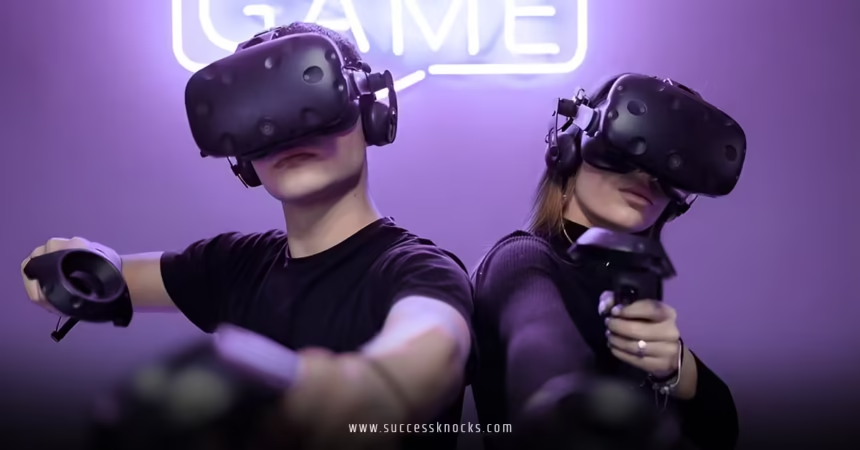
How VR is changing esports competitions isn’t just about slapping on a headset and calling it innovation. We’re witnessing a fundamental shift in how players compete, audiences engage, and tournaments operate. Virtual reality is breaking down the barriers between player and game, creating experiences that make traditional esports look like watching paint dry.
The VR esports transformation at a glance
Here’s what’s actually happening in the VR esports space right now:
- Physical engagement: Players use their entire bodies, not just fingers and wrists
- Spectator immersion: Audiences can literally step inside the competition arena
- New game categories: Sports simulations and physical challenges dominate over traditional shooters
- Accessibility barriers: Equipment costs and space requirements create participation hurdles
- Tournament evolution: Events require specialized venues with room-scale setups
This isn’t your typical gaming evolution. It’s a complete reimagining of what competitive gaming can be.
What makes VR esports fundamentally different
The physicality factor
Traditional esports athletes sit in chairs for hours. VR competitors? They’re dodging, ducking, swinging, and breaking a legitimate sweat. Games like Beat Saber tournaments showcase this perfectly—players need actual rhythm, coordination, and stamina to compete at the highest levels.
The skill ceiling is entirely different. You can’t just grind mechanics in training mode. Your body becomes the limiting factor, and that changes everything about how players prepare and compete.
Spectator experience revolution
Remember watching esports on a flat screen and trying to follow the action? VR tournaments let spectators become virtual flies on the wall. They can choose camera angles, follow specific players, or even experience the game from a competitor’s perspective.
Some tournaments are experimenting with mixed reality broadcasts where viewers see both the physical player movements and their virtual actions simultaneously. It’s like having X-ray vision into the competition.
Current VR esports landscape breakdown
| Game Category | Popular Titles | Tournament Prize Pools | Skill Requirements |
|---|---|---|---|
| Rhythm Games | Beat Saber, Synth Riders | $10K-$50K | Hand-eye coordination, stamina |
| Sports Sims | Eleven Table Tennis, The Thrill of the Fight | $5K-$25K | Real sport skills, strategy |
| Shooters | Onward, Pavlov VR | $15K-$75K | Tactical awareness, physical movement |
| Racing | Project CARS VR, Dirt Rally | $20K-$100K | Precision driving, spatial awareness |
The prize pools might seem modest compared to traditional esports, but they’re growing fast. More importantly, the skill diversity is unprecedented.
How VR is reshaping tournament infrastructure
Venue requirements
Forget cramped gaming setups. VR tournaments need serious real estate. Each player requires roughly 6×6 feet of clear space, specialized tracking equipment, and powerful PCs tethered nearby. Tournament organizers are essentially building temporary holodeck arrays.
The logistics are intense. Cable management alone becomes a safety issue when players are moving around with expensive headsets strapped to their faces.
Technical challenges
Latency that’s barely noticeable in traditional gaming becomes game-breaking in VR. Players need consistent 90fps minimum, or motion sickness kills competitive performance. Tournament organizers invest heavily in dedicated hardware and network infrastructure.
Then there’s the human factor—players can’t compete for hours straight like traditional esports athletes. Physical fatigue sets realistic limits on tournament formats.
The accessibility revolution (and its problems)
Breaking down barriers
VR esports is accidentally more inclusive in some ways. Physical disabilities that prevent traditional gaming sometimes don’t apply in virtual spaces. Seated VR experiences can level playing fields that real-world sports never could.
Age ranges are broader too. Older competitors who can’t match teenage reflexes in traditional esports find success in VR games that reward experience and strategy over pure twitch responses.
Creating new barriers
But let’s be honest about the downsides. Entry costs are brutal. A competitive VR setup runs $1,500-$3,000 minimum. Compare that to the $500 console setup that gets you into traditional esports.
Space requirements exclude apartment dwellers and anyone without dedicated gaming rooms. The technology itself still causes motion sickness in 15-20% of users, according to research from Stanford’s Virtual Human Interaction Lab.
Training methodologies that didn’t exist before
Physical conditioning
VR esports athletes are hiring personal trainers. No kidding. Games like The Thrill of the Fight require actual boxing conditioning. Beat Saber professionals work on flexibility and endurance training.
The crossover with real sports is unprecedented in gaming history.
Spatial awareness development
Traditional gamers develop hand-eye coordination and reaction times. VR competitors build three-dimensional spatial intelligence and proprioception—awareness of their body position in space.
Training regimens include balance exercises, yoga, and real-world activities that transfer into virtual performance.
Broadcasting and audience engagement evolution
Multi-perspective viewing
Traditional esports broadcasts show one screen. VR tournaments can offer dozens of simultaneous viewpoints. Spectators choose their experience—follow one player, get an overview shot, or watch from inside the game world.
The technology exists for 360-degree tournament broadcasts where viewers control their own camera using VR headsets. It’s still niche, but growing fast.
Interactive spectating
Some VR tournaments let audiences influence matches through voting, cheering mechanics that affect in-game elements, or even joining as virtual spectators inside the competition space.
This blurs the line between watching and participating in ways that traditional sports never could.
Common mistakes organizations make entering VR esports
Here’s where most newcomers mess up:
- Underestimating space requirements: Plan for 2x more room than you think you need
- Ignoring motion sickness protocols: Build in mandatory breaks and have backup players ready
- Cheap equipment choices: Budget headsets create inconsistent competitive experiences
- Traditional broadcast thinking: VR tournaments need entirely different production approaches
- Neglecting physical safety: Trip hazards and equipment damage are real concerns
The learning curve is steep, and expensive mistakes happen fast.
Step-by-step action plan for getting involved
For aspiring competitors:
- Test your VR tolerance: Spend 30 minutes in VR daily for a week before investing in equipment
- Choose your niche early: VR esports skills don’t transfer between games like traditional gaming
- Build physical conditioning: Start with basic cardio and flexibility training
- Join community tournaments: Local VR arcades often host small competitions
- Invest in quality equipment gradually: Start with a solid headset, upgrade peripherals later
For tournament organizers:
- Secure appropriate venues: Look for event spaces with high ceilings and modular layouts
- Partner with VR arcade chains: They understand the equipment and safety requirements
- Plan for technical support: VR setups fail more often than traditional gaming rigs
- Design shorter match formats: Physical fatigue limits competition length
- Experiment with broadcast options: Traditional streaming doesn’t showcase VR effectively
Future implications for competitive gaming
The trajectory is clear. VR esports will likely split into two distinct categories: seated experiences that emphasize mental competition, and room-scale games that blend gaming with athletic performance.
We’re heading toward a world where “esports athlete” isn’t an oxymoron. Physical conditioning will become as important as strategic thinking and mechanical skill.
The real kicker? Traditional sports organizations are paying attention. The NBA launched NBA 2KVR Experience, and Formula 1 has official VR racing competitions. When legacy sports embrace VR competition, you know the shift is real.
Key takeaways
- VR esports require actual physical skill and conditioning, fundamentally changing competitor preparation
- Tournament infrastructure needs complete reimagining—more space, specialized equipment, safety protocols
- Spectator experiences offer unprecedented immersion and interactivity options
- Entry barriers are high due to equipment costs and space requirements
- Broadcasting needs new approaches that showcase the physical and virtual elements simultaneously
- The skill sets required don’t transfer from traditional esports, creating fresh competitive landscapes
- Major sports organizations are beginning to integrate VR competitions into their ecosystems
- Physical limitations create natural tournament format constraints that don’t exist in traditional gaming
Conclusion
How VR is changing esports competitions comes down to one fundamental shift: gaming is becoming genuinely athletic. We’re watching the birth of a hybrid entertainment form that combines the strategy and skill of traditional esports with real physical demands.
The barriers to entry are real, the technical challenges are significant, and the industry is still figuring out best practices. But the potential is undeniable. VR esports will likely coexist with traditional gaming rather than replace it, serving different audiences and showcasing different skill sets.
Your next step? If you’re curious about VR esports, visit a local VR arcade and try a few competitive games. Feel the difference for yourself. The physicality is immediately apparent, and you’ll understand why this isn’t just gaming with fancy goggles—it’s something entirely new.
The revolution is already here. The question is whether you’re ready to step inside it.
Frequently Asked Questions
Q: How much does it cost to get started in VR esports competitions?
A: Entry-level competitive setups start around $1,500 for a quality headset, capable PC, and necessary accessories. Professional-grade equipment can easily reach $3,000-$5,000. Factor in the space requirements and ongoing game purchases, and the investment becomes substantial compared to traditional esports.
Q: Do VR esports require the same time commitment as traditional competitive gaming?
A: Actually, no. Physical fatigue limits practice sessions to 2-4 hours maximum before performance degrades significantly. This creates a more sustainable competitive environment but requires different training strategies that include physical conditioning alongside game practice.
Q: Can someone with motion sickness compete in VR esports?
A: Motion sensitivity affects about 15-20% of users, but tolerance often improves with gradual exposure. Some VR esports focus on seated experiences with minimal motion, making them accessible to motion-sensitive players. However, room-scale competitive games remain challenging for those who don’t adapt to VR motion.
Q: How are VR esports tournaments different from watching traditional esports?
A: VR tournament broadcasts can offer multiple simultaneous viewpoints, 360-degree cameras, and even let spectators experience matches from competitors’ perspectives using their own VR headsets. The visual spectacle includes both physical player movements and virtual game action, creating a more dynamic viewing experience.
Q: What skills from traditional sports transfer well to VR esports competitions?
A: Hand-eye coordination, spatial awareness, and competitive mental toughness transfer directly. Specific sports skills matter too—real tennis players often dominate VR tennis games, boxers excel in VR fighting games, and racing drivers perform well in VR racing competitions. The crossover potential is much higher than traditional esports.