
Measuring pipeline influence vs lead capture in B2B is about understanding the full spectrum of your marketing and sales efforts. It’s not just about who fills out a form; it’s about every interaction that guides a potential customer towards a purchase, even if it’s subtle. This distinction empowers B2B organizations to allocate resources more effectively, driving genuine revenue growth in 2026 and beyond. Ignoring the nuances between these two concepts means leaving money on the table, missing critical insights into buyer behavior, and ultimately, stifling your growth potential.
Unpacking the Core Concepts: Lead Capture and Pipeline Influence
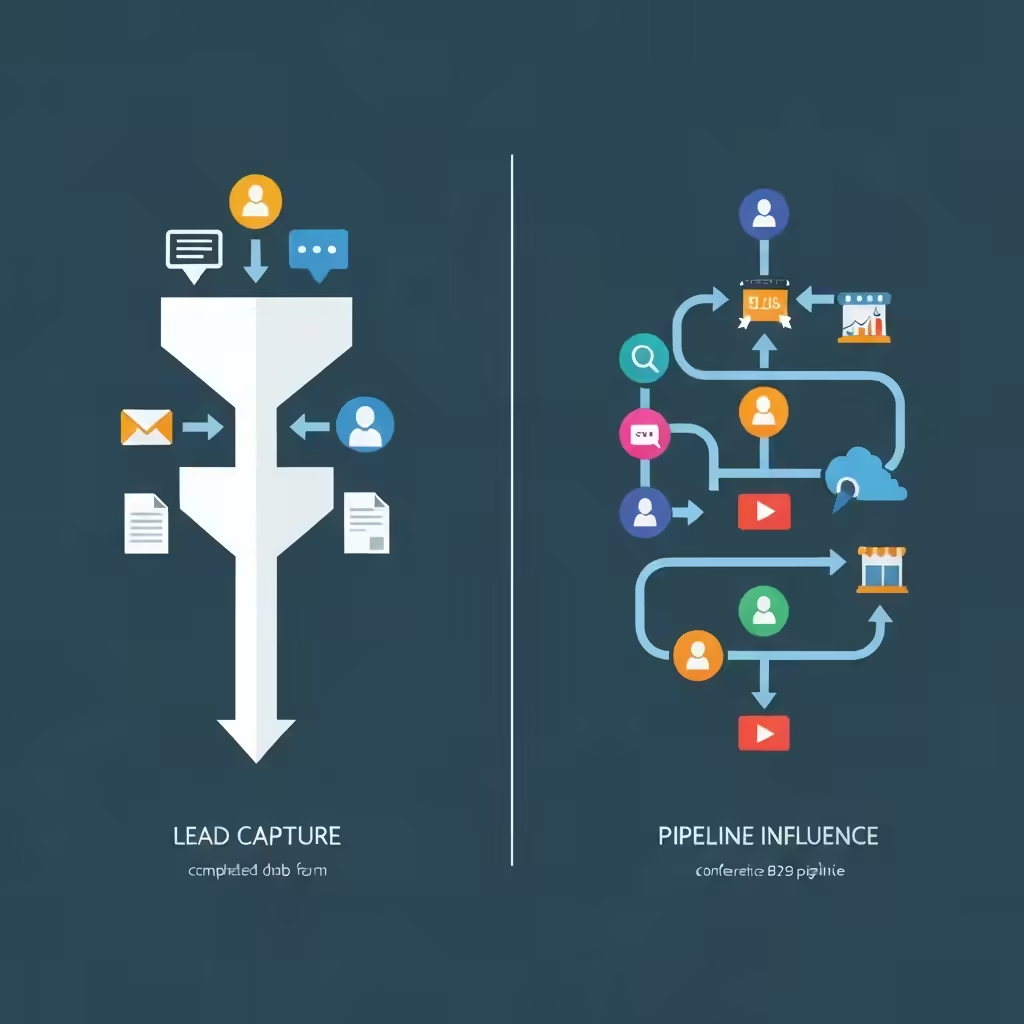
To genuinely master your B2B growth strategy, you first need a crystal-clear understanding of what you’re measuring. The terms “lead capture” and “pipeline influence” often get muddled. They are related, certainly, but not interchangeable. Grasping their individual definitions is the bedrock of effective measurement.
What Exactly is Lead Capture?
Lead capture is the direct act of acquiring contact information from a potential customer. This is the moment someone raises their hand, however slightly, and says, “I’m interested.” Think about it. This happens when a prospect:
- Fills out a contact form on your website.
- Downloads a whitepaper or ebook.
- Registers for a webinar.
- Subscribes to your newsletter.
- Requests a demo or consultation.
These are all measurable, explicit actions. The goal here is to gather enough data to initiate a sales conversation or nurture the lead further. It’s about building your database. It’s about getting names and email addresses. Easy to track, right? You see the submission, you get the lead.
What is Pipeline Influence?
Pipeline influence, on the other hand, is a much broader, more strategic concept. It encompasses every marketing and sales activity that contributes to moving a prospect through the sales pipeline, from initial awareness to closed-won deal, regardless of whether that activity directly captured a lead. This is about the journey, not just the destination.
Consider the countless touchpoints a B2B buyer might encounter before they ever become a “lead.” They might:
- Read a blog post.
- Watch a YouTube video.
- Engage with your brand on social media.
- Attend an industry conference where your company had a booth.
- See a display ad.
- Hear a podcast interview with your CEO.
- Read a third-party review of your product.
None of these directly capture lead information. Yet, each interaction builds brand awareness, educates the prospect, and shapes their perception. They contribute to the eventual decision. That’s pipeline influence. It’s the cumulative impact of all your efforts on the sales cycle.
Why the Distinction Matters for B2B Success
Understanding the difference isn’t just academic. It’s fundamental to optimizing your marketing spend and sales strategy. If you only focus on lead capture, you might undervalue activities that build long-term trust and educate buyers. You could be missing the forest for the trees.
Conversely, if you only focus on broad influence without a solid lead capture mechanism, you’ll struggle to convert that interest into tangible opportunities. Both are essential. The kicker is knowing how to measure each effectively and how they interact. It’s like distinguishing between the rain that fills a reservoir (influence) and the tap that draws water from it (lead capture). Both are necessary for hydration.
The Evolution of B2B Measurement: Beyond Last-Touch Attribution
The way B2B organizations measure success has evolved dramatically. Gone are the days when a simple “last-touch” model, crediting only the final interaction before conversion, was sufficient. Buyers in 2026 navigate incredibly complex digital landscapes. Their journeys are winding paths, not straight lines.
From Simple Forms to Complex Buyer Journeys
Early B2B marketing often relied on direct mail or simple landing pages. A prospect saw an ad, filled out a form, and became a lead. The attribution was straightforward. The form got the credit.
Today, buyers conduct extensive research online. They might interact with dozens of pieces of content, visit multiple websites, and engage with various social channels before ever speaking to a salesperson. They read reviews, compare solutions, and seek peer advice. This multi-channel engagement makes attributing value to a single touchpoint nearly impossible and certainly inaccurate.
The Challenge of Multi-Touch Attribution
This complexity introduces the challenge of multi-touch attribution. How do you assign credit across numerous interactions? Which touchpoints truly moved the needle? Was it the initial blog post that sparked interest, the webinar that educated them, or the case study that sealed the deal?
Accurately measuring pipeline influence vs lead capture in B2B means grappling with this challenge. It demands a more sophisticated approach than simply counting form fills. You need to understand the sequence and weight of each interaction. What usually happens is that marketing teams struggle to prove ROI because their measurement tools aren’t sophisticated enough to track the full buyer journey.
Deep Dive: Measuring Lead Capture Effectiveness
Measuring lead capture is often the easiest part of the equation, but “easy” doesn’t mean “simple.” Effective lead capture goes beyond just counting raw numbers. It requires a keen eye on quality, conversion rates, and the subsequent journey of those captured leads.
Key Metrics for Lead Capture
When you’re focused on lead capture, these are the metrics that matter most:
- Conversion Rate: The percentage of visitors who complete a desired action (e.g., fill out a form). If 100 people visit your landing page and 10 fill out the form, your conversion rate is 10%.
- Cost Per Lead (CPL): How much you spend to acquire a single lead. Divide your total campaign cost by the number of leads generated.
- Lead Volume: The sheer number of leads generated within a specific timeframe. While not the sole indicator of success, it’s a foundational metric.
- Lead Quality: This is where it gets interesting. Not all leads are created equal. Are your captured leads actually turning into qualified opportunities? This requires collaboration with sales.
- Marketing Qualified Leads (MQLs): Leads that meet specific criteria indicating a higher likelihood of becoming a customer, based on their engagement and demographic information.
- Sales Qualified Leads (SQLs): MQLs that have been reviewed and accepted by the sales team as ready for direct sales engagement.
Optimizing Lead Capture Channels
Every channel has its strengths and weaknesses for lead capture.
- Website Forms: Essential. Optimize for simplicity and clear calls to action.
- Landing Pages: Dedicated pages for specific offers, designed to maximize conversions. A well-designed landing page can dramatically boost your capture rates.
- Content Gating: Requiring an email address to access premium content (whitepapers, templates). The perceived value must justify the ask.
- Webinars & Events: Excellent for capturing engaged prospects. People who commit an hour of their time are usually quite interested.
- Social Media: While often more about influence, targeted lead generation ads can be effective.
In my experience, A/B testing different form fields, calls to action, and page layouts can yield significant improvements in lead capture rates. Small changes often lead to big wins.
Lead Quality vs. Quantity: The Eternal Debate
Here’s the thing: it’s tempting to chase high lead volumes. More leads, more sales, right? Not necessarily. A flood of unqualified leads can overwhelm your sales team, waste resources, and deflate morale. It’s a false economy.
The focus should always be on lead quality. A smaller number of highly qualified leads will likely generate more revenue than a massive influx of low-quality ones. This means aligning your marketing and sales teams on what constitutes a “good” lead. Develop clear lead scoring criteria to prioritize prospects who are genuinely a good fit for your solution.
Unpacking Pipeline Influence Measurement
This is where the real complexity, and often the real value, lies. Measuring pipeline influence means moving beyond direct conversions and understanding the full scope of your marketing’s impact on revenue. It’s about tracing the breadcrumbs through the entire buyer journey.
Identifying Influential Touchpoints
The first step in measuring pipeline influence is to identify all potential touchpoints. This isn’t just your website. It includes:
- Content Interactions: Blog posts, articles, videos, podcasts, infographics.
- Email Marketing: Nurture sequences, promotional emails.
- Paid Advertising: Search ads, display ads, social media ads.
- Organic Search: How prospects find you through search engines.
- Social Media Engagement: Likes, shares, comments, direct messages.
- PR & Media Mentions: Features in industry publications.
- Events & Webinars: Even if no form was filled at first contact.
- Sales Interactions: Every call, email, or meeting.
Mapping these touchpoints against your customer journey is paramount. Every interaction, however small, chips away at resistance or builds familiarity.
Attribution Models for Pipeline Influence
This is the engine of pipeline influence measurement. An attribution model assigns value to each touchpoint in the customer journey that contributes to a conversion. There are several common models, each with its own perspective:
First-Touch Attribution
- Concept: Gives 100% of the credit to the very first interaction a prospect had with your brand.
- Use Case: Excellent for understanding initial awareness and demand generation efforts. “What initially brought them to us?”
- Limitation: Ignores all subsequent interactions that might have been critical in nurturing the lead.
Last-Touch Attribution
- Concept: Gives 100% of the credit to the final interaction before a conversion.
- Use Case: Good for understanding which channels are best at closing deals. “What was the final push?”
- Limitation: Overlooks all the foundational work done by earlier marketing efforts.
Linear Attribution
- Concept: Distributes credit equally across all touchpoints in the customer journey.
- Use Case: Provides a balanced view, acknowledging every interaction played a part.
- Limitation: May not accurately reflect the true impact of more significant touchpoints.
U-Shaped (or Position-Based) Attribution
- Concept: Assigns more credit to the first and last touchpoints (often 40% each), with the remaining 20% distributed evenly among middle interactions.
- Use Case: Values both initial awareness and final conversion, while still recognizing nurturing efforts.
- Limitation: The 40/20/40 split is arbitrary; actual influence might vary.
W-Shaped Attribution
- Concept: Gives significant credit to the first touch, lead creation, and opportunity creation touchpoints, with the remaining credit distributed among other interactions.
- Use Case: Ideal for longer B2B sales cycles where multiple milestones are critical.
- Limitation: Requires robust tracking of specific milestone events.
Time Decay Attribution
- Concept: Gives more credit to touchpoints that occurred closer in time to the conversion.
- Use Case: Useful for understanding the impact of recent interactions, especially in shorter sales cycles.
- Limitation: Can undervalue early, foundational touches.
Custom Attribution
- Concept: You define the rules and weights for each touchpoint based on your specific business and buyer journey.
- Use Case: Offers the most accurate reflection of your unique B2B sales process.
- Limitation: Requires deep understanding of your data and significant setup.
Choosing the right model, or combination of models, is key to accurately measuring pipeline influence. In my experience, a multi-touch model like U-shaped or W-shaped often provides the most actionable insights for B2B.
The Role of Content in Pipeline Influence
Content marketing is a massive driver of pipeline influence. A prospect might read five of your blog posts, watch a product demo video, and then download a comparative guide before ever filling out a form. These are all influential touchpoints.
Think about how you can create content that addresses different stages of the buyer journey, from problem awareness to solution evaluation. Each piece plays a role in educating, building trust, and moving the prospect closer to a decision. For instance, creating compelling content can be key to achieving rapid marketing success online.
Sales Enablement’s Impact on Pipeline Influence
Sales enablement isn’t just about providing battle cards. It’s about empowering your sales team with content, tools, and training that help them influence prospects effectively. When sales reps have access to relevant case studies, competitive analysis, and personalized presentation decks, they become more influential. This directly impacts deal velocity and conversion rates.
The Synergy: How Lead Capture and Pipeline Influence Work Together
It’s not an either/or situation. Effective B2B growth relies on both lead capture and pipeline influence working in harmony. They are two sides of the same coin, each essential for a thriving revenue engine.
A Holistic View of the Buyer Journey
Imagine the buyer journey as a complex machine. Lead capture is a specific lever that brings a new part into the system. Pipeline influence is all the gears, pulleys, and intricate mechanisms that move that part through the machine until it becomes a finished product. You need both.
A holistic view means understanding:
- Awareness & Education: How do prospects first discover you and learn about their problem? (Influence)
- Engagement & Nurturing: How do they interact with your content and brand over time? (Influence)
- Conversion: When do they formally become a lead? (Capture)
- Qualification & Opportunity: How do they progress from MQL to SQL to a sales opportunity? (Influence & Capture)
- Deal Closure: What factors contribute to winning the deal? (Influence)
Each stage demands different strategies and measurement approaches.
Aligning Marketing and Sales Efforts
This is perhaps the most critical component. Marketing generates interest and captures leads. Sales converts those leads into customers. Without tight alignment, efforts are wasted. Marketing might capture leads that sales deems unqualified. Sales might struggle to close deals because marketing hasn’t adequately influenced the prospect.
When measuring pipeline influence vs lead capture in B2B, sales and marketing teams must:
- Agree on definitions: What is an MQL? What is an SQL?
- Share data: Marketing needs sales feedback on lead quality. Sales needs visibility into marketing touchpoints.
- Collaborate on content: Marketing creates content that sales needs.
- Develop shared goals: Both teams should be working towards the same revenue targets.
This alignment transforms individual efforts into a powerful, unified revenue engine.
Practical Strategies for Measuring Pipeline Influence vs Lead Capture in B2B
Now, let’s get practical. How do you actually implement these concepts and measure them effectively in your B2B organization? It requires a blend of technology, process, and continuous optimization.
Implementing Robust CRM and Marketing Automation
You cannot measure what you cannot track. A powerful Customer Relationship Management (CRM) system and a comprehensive marketing automation platform are non-negotiable.
- CRM (e.g., Salesforce, HubSpot CRM): This is your single source of truth for customer data. It tracks every sales interaction, deal stage, and customer history.
- Marketing Automation (e.g., HubSpot Marketing Hub, Marketo, Pardot): This system tracks all marketing touchpoints – website visits, content downloads, email opens, ad clicks. It connects these actions to individual leads.
The integration between these two systems is absolutely essential. It allows you to see the full journey of a prospect, from their first anonymous website visit to a closed-won deal, stitching together marketing influence with lead capture.
Building a Comprehensive Attribution Model
As discussed, choosing the right attribution model is paramount. Don’t just pick one and forget it.
- Start Simple: If you’re new to attribution, begin with a basic multi-touch model like linear or U-shaped.
- Gather Data: Collect data on all your touchpoints. This means setting up UTM tracking parameters for all campaigns, ensuring your marketing automation is tracking web activity, and logging all sales interactions in your CRM.
- Analyze and Refine: Regularly review your attribution reports. Do certain channels consistently appear at the beginning of successful journeys? Do others always provide the final push? Use these insights to refine your model.
- Consider Customization: As you mature, you might build a custom model that assigns different weights to different touchpoints based on your unique buyer journey and business goals.
Regularly Reviewing Data & Adjusting Strategy
Measurement isn’t a one-time task. It’s an ongoing process.
- Weekly/Monthly Reviews: Dedicate time to review your lead capture metrics (conversion rates, CPL, MQLs) and pipeline influence reports.
- Identify Trends: Are certain content types consistently influencing deals? Are particular lead capture channels underperforming?
- A/B Test: Continuously test different landing page designs, ad creatives, email subject lines, and content formats to optimize both capture and influence.
- Feedback Loop: Ensure there’s a constant feedback loop between marketing and sales. Marketing needs to know which leads are truly valuable, and sales needs to understand the marketing context behind each lead. This is where scaling and growing your healthcare business or any other niche can find common ground in operational efficiency.
B2B Pipeline Influence & Lead Capture Checklist for 2026
Here’s a quick checklist to ensure you’re on track for robust measurement:
- Defined Lead Stages: Clear definitions for MQL, SQL, Opportunity.
- Integrated Tech Stack: CRM and marketing automation are connected and sharing data.
- Comprehensive Tracking: UTM parameters in place for all campaigns.
- Attribution Model Selected: A multi-touch model (e.g., U-shaped, W-shaped) is configured.
- Content Mapping: Content aligned to different stages of the buyer journey.
- Sales-Marketing SLA: Service Level Agreement defining responsibilities and handoffs.
- Regular Reporting: Monthly reports on lead capture and pipeline influence.
- Feedback Loop Established: Consistent communication between sales and marketing.
- Experimentation Culture: Willingness to A/B test and optimize.
- Focus on Revenue: Ultimately, all metrics tied back to revenue impact.
Common Pitfalls and How to Avoid Them
Even with the best intentions, organizations often stumble when trying to measure pipeline influence vs lead capture in B2B. Recognizing these common traps can help you navigate around them.
Ignoring Dark Funnel Activities
The “dark funnel” refers to buyer activities that are difficult to track with traditional tools. Think private Slack communities, word-of-mouth referrals, anonymous forum discussions, or conversations at industry events. These activities heavily influence buying decisions but don’t show up in your analytics.
How to Avoid: While you can’t track everything, you can get insights. Incorporate “how did you hear about us?” questions in forms and sales calls. Ask about specific content they found helpful. Monitor online communities for mentions of your brand or industry topics. This qualitative data complements your quantitative metrics.
Misinterpreting Data
Numbers alone don’t tell the whole story. A high conversion rate on a landing page might look great, but if those leads never convert to customers, the metric is misleading. Similarly, a channel with low direct lead capture might have massive pipeline influence.
How to Avoid: Always look at data in context. Correlate lead capture metrics with sales outcomes. Analyze which touchpoints are present in successful deals. Don’t just report on vanity metrics; focus on metrics that directly tie to revenue. Ask “why?” repeatedly when reviewing your reports.
Lack of Sales-Marketing Alignment
This is the biggest killer of effective measurement. If sales and marketing aren’t on the same page about lead definitions, handoff processes, and shared goals, your data will be fragmented and your efforts inefficient. Marketing might celebrate a lead volume that sales finds useless. Sales might complain about lead quality without providing specific feedback.
How to Avoid: Establish a formal Service Level Agreement (SLA) between sales and marketing. Define what an MQL and SQL are. Set clear expectations for lead follow-up. Hold regular joint meetings to review pipeline performance, discuss lead quality, and share insights. True alignment means both teams feel ownership over the entire revenue process. It’s a journey, much like understanding equity funding vs debt financing small business options.
What I’d Do: A Practitioner’s Perspective
If I were tasked with setting up or refining the measurement of pipeline influence vs lead capture in B2B for a company today, here’s my roadmap. It’s built on years of seeing what actually works and what just creates noise.
Focus on the “Why” Behind the “What”
Before diving into tools or metrics, I’d gather the key stakeholders – marketing, sales leadership, and even product – and ask: “Why are we doing this? What specific business questions do we need to answer?” Do we need to prove marketing ROI? Optimize budget allocation? Understand buyer behavior better? The answers will dictate which metrics and attribution models are most relevant. Without a clear “why,” you risk collecting data for data’s sake.
Invest in Technology, But Don’t Over-Automate Your Brain
A robust CRM and marketing automation platform are foundational. I’d ensure they’re deeply integrated. But here’s the kicker: don’t let the tech do all your thinking. Tools provide data. Humans provide insight. I’d train teams not just on how to use the platforms, but how to interpret the reports, identify anomalies, and ask probing questions. A sophisticated tool is only as good as the analyst behind it. For example, understanding how different businesses online vs in person profits can be influenced by these tools requires human insight.
Embrace Experimentation and Iteration
The B2B landscape is dynamic. What works today might not work tomorrow. I’d foster a culture of continuous experimentation. A/B test everything: landing page headlines, email subject lines, ad creatives, even the content formats you gate for lead capture. For pipeline influence, experiment with different content types at various stages of the journey. Measure the impact, learn, and iterate. This isn’t about perfection; it’s about constant improvement. You wouldn’t expect to master a complex skill like welding to press braking 10 metal fabrication techniques explained without practice and refinement, and marketing measurement is no different.
Conclusion
Measuring pipeline influence vs lead capture in B2B is no longer a luxury; it’s a necessity for any organization aiming for sustainable growth in 2026. Lead capture provides the immediate gratification and the raw material for your sales efforts. Pipeline influence, however, offers the deeper understanding of how your entire marketing ecosystem contributes to revenue, long before a form is ever filled.
By understanding the distinction, implementing robust tracking systems, adopting sophisticated attribution models, and fostering relentless alignment between sales and marketing, you can move beyond simple lead counting. You can gain profound insights into your customer’s journey, optimize your investments, and build a truly powerful revenue engine. The goal isn’t just to get more leads; it’s to create more customers, more efficiently. That requires seeing the whole picture.
Frequently Asked Questions
What is the primary difference between lead capture and pipeline influence?
Lead capture focuses on the explicit act of acquiring contact information from a prospect, like a form submission. Pipeline influence, on the other hand, encompasses all marketing and sales activities that contribute to moving a prospect through the sales funnel, regardless of whether they directly captured a lead. It’s about the full journey.
Why is it important to measure both lead capture and pipeline influence in B2B?
Measuring both provides a holistic view of your marketing and sales effectiveness. Focusing only on lead capture can undervalue critical brand-building and nurturing activities. Conversely, ignoring lead capture means you won’t have the necessary contact information to convert interest into tangible opportunities. Both are essential for optimizing resource allocation and driving revenue.
What are some common metrics for measuring lead capture?
Key metrics for lead capture include conversion rate (visitors to leads), cost per lead (CPL), lead volume, and the number of Marketing Qualified Leads (MQLs) and Sales Qualified Leads (SQLs). These metrics help assess the efficiency and quality of your lead generation efforts.
How do attribution models help in measuring pipeline influence?
Attribution models assign credit to different marketing and sales touchpoints along the customer journey. By using models like First-Touch, Last-Touch, Linear, U-Shaped, or W-Shaped, you can understand which interactions are most influential in guiding a prospect towards a purchase, even if they don’t directly capture a lead.
What is the “dark funnel” and how does it relate to pipeline influence?
The “dark funnel” refers to buyer activities that are difficult to track with traditional analytics, such as private community discussions, word-of-mouth referrals, or anonymous content consumption. These activities significantly influence purchasing decisions and are a part of pipeline influence, even though they don’t show up in your CRM. Gathering qualitative data can help shed light on these.
What role does sales-marketing alignment play in measuring pipeline influence vs lead capture in B2B?
Sales-marketing alignment is absolutely critical. Without it, lead definitions might differ, data sharing can be poor, and feedback loops are missing. This leads to fragmented data and inefficient processes. Aligned teams collaborate on shared goals, ensuring that both lead capture and pipeline influence efforts are coordinated and effective in generating revenue.
Can a company rely solely on lead capture metrics for B2B growth?
No, relying solely on lead capture metrics is a common pitfall. While lead capture is important for filling your pipeline, it often fails to account for the extensive research and engagement that B2B buyers undertake before becoming a formal lead. Ignoring pipeline influence can lead to misallocated budgets and a misunderstanding of what truly drives customer acquisition.
What is one practical step I can take today to improve my measurement?
Integrate your CRM and marketing automation platforms. This foundational step allows you to connect marketing touchpoints with sales outcomes, providing a unified view of the customer journey. Without this integration, accurately measuring both lead capture and pipeline influence becomes significantly more challenging.