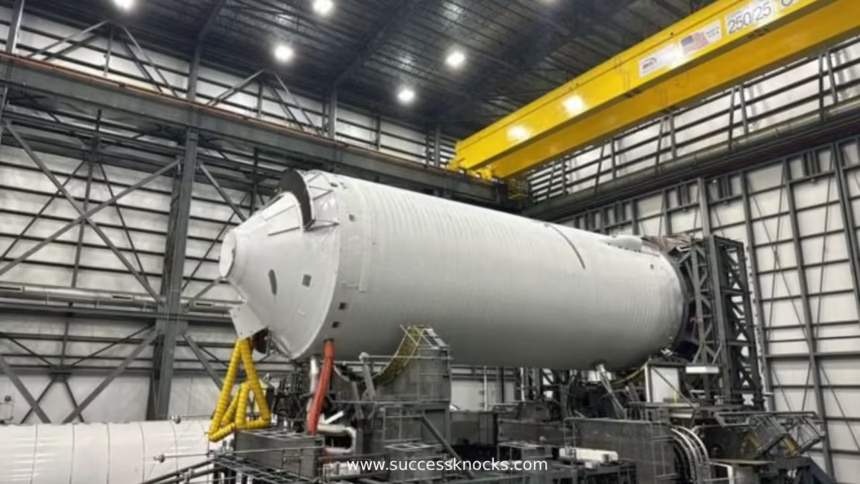
New Glenn Rocket Specifications reveal one of the most ambitious heavy-lift vehicles in modern commercial spaceflight. Standing 98 meters tall with a 7-meter diameter, this two-stage rocket from Blue Origin packs serious punch using powerful BE-4 engines while prioritizing reusability and high payload capacity.
Here’s the deal. While recent events like the Blue Origin rocket explosion Cape Canaveral update grabbed headlines, understanding the core specs shows why Blue Origin keeps pushing forward despite setbacks.
- Height: 98 m (322 ft) — nearly as tall as the Statue of Liberty stacked on itself.
- Diameter: 7 m — offering massive internal volume.
- Payload to LEO: Up to 45,000 kg (standard 7×2 configuration).
- Engines: Seven BE-4 on first stage, two BE-3U on second.
- Propellant: Liquid oxygen and liquefied natural gas (methane).
- Reusability: First stage designed for multiple flights with vertical landing capability.
These numbers position New Glenn as a direct competitor to SpaceX’s Falcon Heavy and a stepping stone toward even heavier lift.
Breaking Down New Glenn Rocket Specifications: Size and Structure
The rocket towers at 98 meters. Its first stage alone stretches about 57.5 meters. That wide 7-meter body gives it double the volume of traditional 5-meter fairings, perfect for bulky satellites or constellation deployments.
The kicker is this isn’t just big for show. The design supports rapid refurbishment at facilities right near Cape Canaveral’s LC-36. Build, launch, land, repeat — all within a tight geographic loop.
A larger 8.7-meter fairing variant (9×4 configuration) is already in planning for even bigger missions.
First Stage Deep Dive
- Engines: 7 × BE-4 (oxygen-rich staged combustion)
- Thrust: Approximately 19,928 kN (about 4.48 million lbf) combined at sea level
- Propellant: LOX / LNG
- Burn Time: Around 190 seconds
- Reusability Target: Multiple flights per booster
Each BE-4 delivers roughly 640,000 lbf individually. These engines also power ULA’s Vulcan, proving their real-world pedigree.
New Glenn Rocket Specifications: Performance and Payload Capabilities
Blue Origin quotes strong numbers for different orbits:
| Configuration | LEO Payload | GTO Payload | TLI Payload | Notes |
|---|---|---|---|---|
| 7×2 (Standard) | 45,000 kg | 13,600 kg | 7,000 kg | Current primary version |
| 9×4 (Upgraded) | >70,000 kg | ~14,000 kg | >20,000 kg | Larger fairing, more engines |
These figures make New Glenn ideal for Amazon’s Project Kuiper (now often called Amazon Leo), national security payloads, and potential lunar missions.
What usually happens is customers get flexibility. The wide fairing lets them stack more satellites creatively without custom adapters.
Upper Stage Performance
The second stage uses two BE-3U engines burning liquid hydrogen and oxygen. This combo excels at high-energy orbits. Recent upgrades have increased thrust, improving overall performance margins.
In my experience watching these programs, the upper stage often determines mission success for complex deployments. Blue Origin has iterated here after early flights.
How New Glenn Stacks Up: Quick Comparison
| Rocket | Height | LEO Payload | Reusable Stage | Primary Fuel |
|---|---|---|---|---|
| New Glenn 7×2 | 98 m | 45 t | Yes (Booster) | Methane/LOX |
| Falcon Heavy | 70 m | ~64 t | Yes | Kerosene/LOX |
| Starship | ~120 m | 100+ t | Full | Methane/LOX |
New Glenn sits in a sweet spot — big enough for serious work but not Starship-scale complexity yet.
New Glenn Rocket Specifications in Context of Recent Events
Following the Blue Origin rocket explosion Cape Canaveral update during a recent hotfire test at LC-36, questions about hardware resilience popped up. But specs don’t lie: the BE-4 engines have flown successfully on previous missions, and the overall architecture emphasizes safety margins.
Explosions during ground tests catch issues early. The real story is how quickly Blue Origin rebounds with data-driven fixes.

Step-by-Step: What Beginners Should Know About These Specs
- Start with Scale — Visualize 98 meters. Walk past a tall building for reference.
- Understand Thrust — Those seven BE-4s create massive liftoff power, but controlled.
- Factor Reusability — First stage landing is key to lowering costs over time.
- Check Orbit Needs — Match your mission (LEO vs GTO) to the right configuration.
- Watch Upgrades — The shift to 9×4 shows Blue Origin isn’t standing still.
What I’d do if explaining this to a new space fan: Pull up Blue Origin’s official site and cross-reference with independent trackers. Don’t just chase viral explosion videos — study the engineering.
Common Mistakes When Reviewing New Glenn Rocket Specifications
- Mistake: Assuming advertised 45t to LEO is guaranteed on every flight.
Fix: Real performance depends on orbit, recovery profile, and margins. Early flights often fly conservatively. - Mistake: Ignoring the 9×4 upgrade path.
Fix: This variant dramatically boosts capability for lunar or mega-constellation work. - Mistake: Comparing only thrust without reusability economics.
Fix: Factor in turnaround time and per-launch cost over multiple flights. - Mistake: Overlooking pad infrastructure needs.
Fix: LC-36 at Cape Canaveral is purpose-built, but incidents like the recent anomaly highlight how ground systems matter.
Future of New Glenn Rocket Specifications
Blue Origin continues refining. Higher-thrust BE-4 variants, subcooled propellants, and reusable fairings are on the horizon. The goal? Reliable cadence supporting both commercial giants like Amazon and government programs including Artemis.
This rocket isn’t just hardware. It’s Blue Origin’s bet on sustainable access to space.
Key Takeaways
- New Glenn stands 98m tall with a 7m diameter for massive payload volume.
- Delivers 45,000 kg to LEO in baseline config, with 9×4 pushing beyond 70 tons.
- Powered by proven BE-4 engines burning clean methane.
- First stage reusability drives long-term cost efficiency.
- Designed and operated near Cape Canaveral for fast turnaround.
- Flexible for LEO constellations, GTO, and deep space missions.
- Recent challenges like the Blue Origin rocket explosion Cape Canaveral update test but don’t define the program.
- Upgrades signal strong growth trajectory.
New Glenn Rocket Specifications paint a picture of serious competition in heavy-lift. Dig into the numbers, follow the test flights, and watch how Blue Origin turns lessons into launches. Head over to official sources for the latest mission profiles and stay curious — the next flight could change the game again.
FAQs
What is the payload capacity according to New Glenn Rocket Specifications?
The standard version targets 45,000 kg to low Earth orbit and 13,600 kg to GTO. Upgraded 9×4 versions aim significantly higher.
How does the New Glenn compare after the Blue Origin rocket explosion Cape Canaveral update?
The incident highlighted test risks, but core specifications remain strong. Investigations will likely lead to refined procedures without changing the fundamental design.
What engines power New Glenn Rocket Specifications?
Seven BE-4 engines on the first stage for liftoff and two BE-3U on the upper stage for orbital insertion. These deliver high performance with methane efficiency.