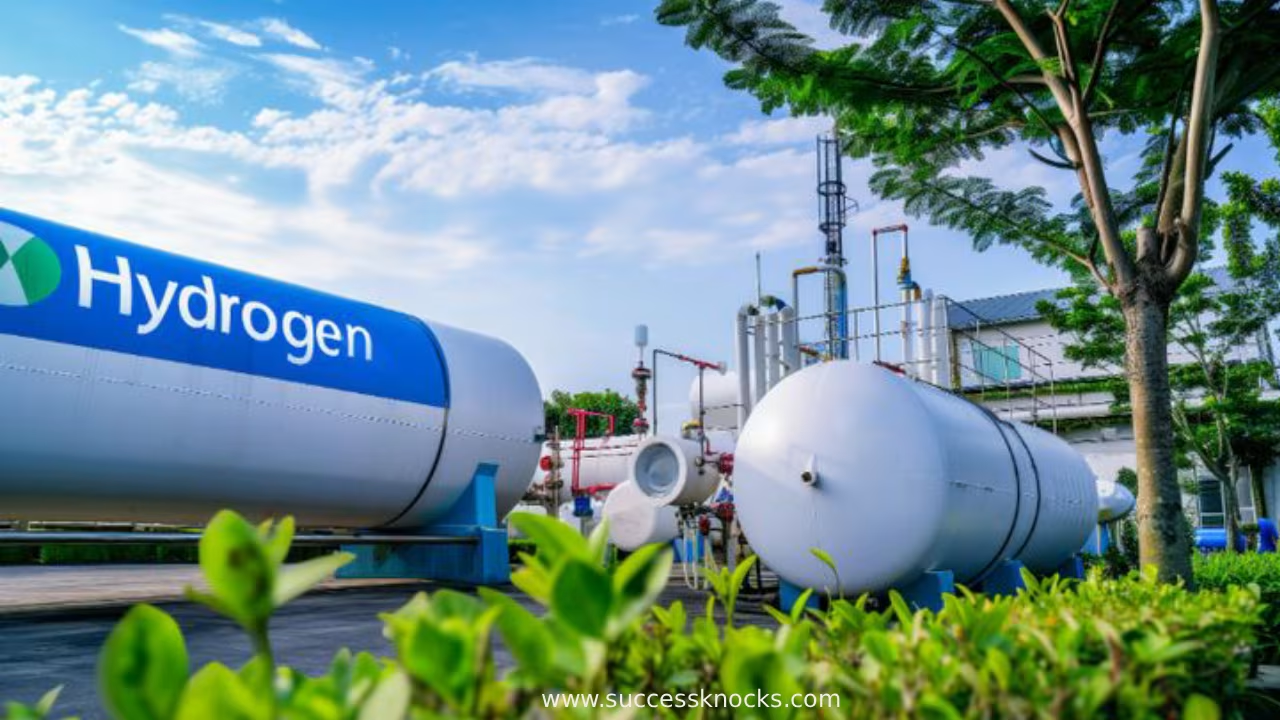
Risks and challenges of entering the green hydrogen sector aren’t just line items buried in a pitch deck — they’re the reason a huge chunk of projects announced back in 2022 and 2023 quietly stalled before construction ever started. This isn’t a doom-and-gloom take. It’s a reality check from someone who’s watched the hype cycle up close.
Here’s the fast version, if you’re short on time:
- Capital costs for electrolyzers and infrastructure remain brutally high, and financing is tight.
- Offtake agreements (buyers committing to purchase hydrogen) are harder to lock down than most newcomers expect.
- Regulatory uncertainty, especially around U.S. tax credits, keeps shifting the math on profitability.
- Water access, grid interconnection delays, and supply chain bottlenecks add operational drag.
- Certification standards for “green” hydrogen are still inconsistent, creating market and reputational risk.
If you’re weighing whether this industry is worth the leap, you need the full picture first. I covered the upside — where the actual money is — in the green hydrogen business opportunities guide, and this piece is the flip side of that coin.
Why the Risks and Challenges of Entering the Green Hydrogen Sector Deserve Your Full Attention
Green hydrogen sounds simple on paper. Run renewable electricity through an electrolyzer, split water into hydrogen and oxygen, sell the hydrogen as a clean fuel or feedstock. Simple in theory. Messy in practice.
The gap between concept and execution is where most newcomers get burned. Capital gets tied up. Timelines slip. Partners walk.
What usually happens is this: an entrepreneur or investor sees the climate tailwinds — decarbonization mandates, corporate net-zero pledges, government subsidies — and assumes demand will just show up. It doesn’t work that way. Demand has to be built, contracted, and defended against cheaper alternatives like blue hydrogen or straight-up natural gas.
That’s the core tension running through everything below.
The Biggest Risks and Challenges of Entering the Green Hydrogen Sector Right Now
Sky-High Capital and Financing Costs
Electrolyzer stacks aren’t cheap, and neither is the renewable power needed to run them around the clock. Add storage, compression, and transport infrastructure, and you’re looking at project costs that can run into hundreds of millions before you’ve sold a single kilogram of hydrogen.
Lenders know this. They’ve gotten more conservative since 2024, wanting firm offtake contracts before they’ll release funds. No buyer lined up? Good luck getting a term sheet.
Offtake Uncertainty — The Chicken-and-Egg Problem
Buyers want proof the hydrogen will actually flow reliably and cheaply. Producers want a signed contract before committing to build. Somebody has to blink first, and in my experience, it’s usually the smaller player who takes the riskier bet just to get a foothold.
This is honestly the single biggest reason projects die quietly. Not bad tech. Not bad intentions. Just nobody willing to go first.
Policy and Tax Credit Volatility
The U.S. 45V clean hydrogen production tax credit, administered through the IRS, has reshaped project economics since it was introduced — but the eligibility rules around “additionality” and hourly matching of renewable power have shifted more than once. A project that’s profitable under one interpretation can turn marginal under another.
If your entire business model hinges on a subsidy that could be tweaked by regulatory guidance, you don’t have a business model. You have a bet.
Water, Grid, and Land Constraints
Electrolysis needs water — a lot of it, in some processes. In water-stressed regions of the American Southwest, that alone can sink a site selection process. Grid interconnection queues, meanwhile, have become a national bottleneck; some projects wait years just for a utility interconnection study.
Certification and “Greenwashing” Risk
Not all hydrogen labeled green actually meets a rigorous emissions standard. The International Energy Agency has flagged inconsistent global certification schemes as a real barrier to market trust. Get this wrong, and you’re not just facing a PR headache — you’re facing buyers who walk when scrutiny increases.
Technology and Scale-Up Risk
PEM and alkaline electrolyzers keep improving, but manufacturing at scale still has real growing pains. Component shortages, quality control issues, and unproven long-term durability all chip away at investor confidence.
Quick-Reference: Risk Category vs. Real-World Impact vs. Mitigation
| Risk Category | Real-World Impact | Practical Mitigation |
|---|---|---|
| Capital Costs | Delayed or canceled financing rounds | Phase project size; seek DOE loan guarantees or state grants |
| Offtake Uncertainty | Stalled construction, idle capacity | Secure anchor customer before breaking ground |
| Policy Volatility | Shifting profit margins mid-project | Model multiple regulatory scenarios, not just the best case |
| Water/Grid Access | Multi-year permitting and interconnection delays | Site selection audit before land purchase, not after |
| Certification Gaps | Buyer distrust, contract cancellations | Pursue recognized third-party certification early |
| Technology Scale-Up | Underperforming output, warranty disputes | Choose vendors with proven commercial-scale track records |
Step-by-Step Action Plan: How to Actually Manage These Risks
- Start small and provable. Pilot at a scale you can fully fund without betting the farm.
- Lock in one anchor buyer before scaling. Even a modest, signed offtake agreement changes your financing conversations completely.
- Run three policy scenarios. Best case, base case, and worst case for tax credit eligibility. If the worst case kills your margins, rethink the project.
- Audit site logistics first. Water rights, grid queue position, and land use permits — check all three before spending on engineering.
- Get certified early, not as an afterthought. Buyers increasingly demand it upfront.
- Build in a 12–18 month buffer. Permitting and interconnection almost always take longer than the optimistic version of your plan.
If you’re an investor rather than an operator, the entry risks look different — smaller checks, different exposure. I broke down those lighter-capital paths in this guide on investing without heavy capital.
Common Mistakes & How to Fix Them
Mistake: Assuming subsidies are permanent.
Fix: Treat tax credits as a bonus, not the foundation of your financial model.
Mistake: Building before securing a buyer.
Fix: Flip the sequence. Contract first, construct second.
Mistake: Underestimating interconnection timelines.
Fix: Talk to your utility during feasibility study, not after land purchase.
Mistake: Skipping certification until launch.
Fix: Engage certification bodies during the design phase — retrofitting compliance later is expensive and slow.
Mistake: Ignoring water stress data.
Fix: Cross-check regional water availability using Department of Energy resources before finalizing a site.
Is the Green Hydrogen Gamble Worth It?
Here’s the thing — nobody who’s serious about this industry pretends it’s risk-free. The risks and challenges of entering the green hydrogen sector are steep enough that plenty of well-funded players have paused or scrapped projects entirely since 2024. But steep isn’t the same as impossible.
Think of it less like flipping a light switch and more like laying rail track in the 1800s — expensive, slow, full of dead ends, but the ones who got the route right ended up owning the corridor. That’s the honest analogy.
Key Takeaways
- Capital intensity remains the number one barrier to entry for smaller players.
- Offtake agreements should come before, not after, major construction spend.
- U.S. tax policy around clean hydrogen credits is still evolving and can move fast.
- Water and grid access constraints vary wildly by region — audit before you commit.
- Certification inconsistency creates real buyer trust and reputational exposure.
- Phased pilots reduce downside risk far more effectively than going big immediately.
- The upside is real, but only for teams who plan around these risks deliberately.
None of this means walk away. It means walk in with your eyes open, your contracts lined up, and your worst-case scenario already modeled. That’s the difference between the projects that survive past year two and the ones that quietly disappear from the news cycle.
FAQs
What is the single biggest risk when entering the green hydrogen sector?
Financing tied to unproven offtake demand tops the list. Without a committed buyer, most lenders won’t fund construction, no matter how strong the technology looks on paper.
Do the risks and challenges of entering the green hydrogen sector differ by U.S. region?
Yes — water availability, grid interconnection queue length, and state-level incentives vary significantly, so a project’s risk profile in Texas looks different from one in California or the Midwest.
Can smaller companies manage the risks and challenges of entering the green hydrogen sector without massive capital?
Small and mid-sized players can reduce exposure by starting with pilot-scale projects, securing a single anchor customer, and focusing on niche applications rather than competing directly on large-scale production.