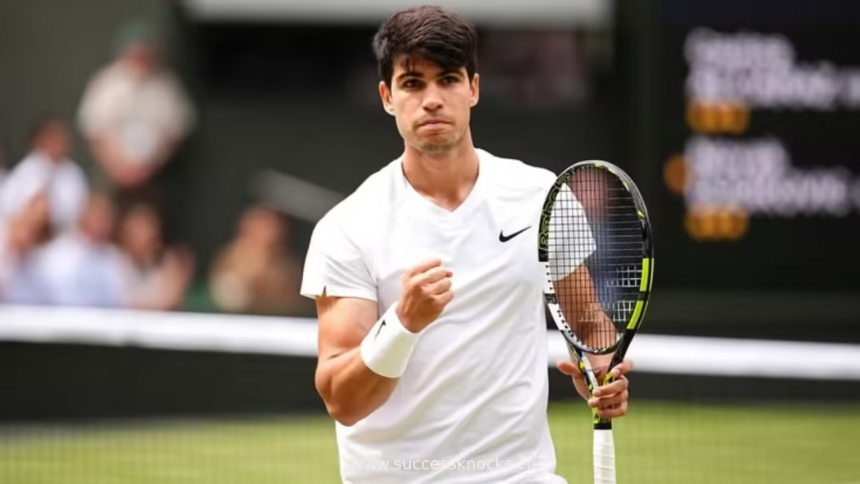
Alcaraz plans long breaks tennis schedule changes after a brutal 2026 that sidelined him for more than four months. This isn’t spin, and it isn’t a throwaway press-conference line. It’s Carlos Alcaraz, sitting in a New York interview room at the US Open, telling reporters flat-out that the tour’s calendar is grinding players down.
Here’s the quick version if you’re skimming:
- Alcaraz missed Roland Garros and Wimbledon in 2026 after a wrist injury at the Barcelona Open in April.
- He now says he’ll voluntarily sit out tournaments going forward — one or two months at a stretch, not four.
- The ATP’s expanded Masters 1000 events (12 days instead of a tight one-week sprint) are fueling his frustration.
- Top players face up to 40 “mandatory” competitive weeks a year if they check every ATP box.
- This signals a real shift in how elite players might manage their careers, not just a passing complaint.
Let’s dig into why this matters, what it means for the sport, and what any player — pro or weekend warrior — can steal from his approach.
Why Alcaraz Plans Long Breaks Tennis Schedule Adjustments Right Now
Timing here is everything. Alcaraz didn’t drop this comment during some quiet off-season chat. He said it mid-tournament, fresh off a grinding four-set win over Jaime Faria at Arthur Ashe Stadium.
He’d just spent four and a half months on the sidelines. Wrist injury, sustained at Barcelona in April. Roland Garros? Gone. Wimbledon? Gone. Two Grand Slams erased from his year — not by choice, but by necessity.
And when he finally came back? He didn’t pin the injury on overplaying. He was clear that the wrist problem wasn’t caused by too much tennis. But that long, frustrating recovery clearly reshaped how he now thinks about pacing an entire season.
“I took more than I wanted, to be honest,” he told reporters, “but seeing how tight the calendar is, I don’t want to have this break because of an injury. In the future, I’m going to take some long breaks.” That quote, confirmed in ESPN’s report on Alcaraz’s return, is now rippling through every tennis forum in the country.
What “Long Breaks” Actually Means for a Top-Three Player
“Taking a break” sounds vague until you look at the math behind it.
Alcaraz isn’t talking about another four-month absence. He’s talking about deliberate, planned gaps — a month here, two months there — carved out on purpose instead of forced on him by injury.
The Numbers Behind Alcaraz’s Long Breaks Tennis Schedule Complaint
Here’s the kicker: if a top player checks every mandatory box — all required Masters 1000s plus four Grand Slams — they’re staring down roughly 40 weeks of competitive tennis in a single year, according to Reuters’ coverage of the ATP’s packed calendar.
Add travel days. Add practice blocks. Add media obligations nobody sees on TV. There’s barely room to breathe, let alone let a nagging wrist or knee actually heal.
Since 2025, seven of the nine ATP Masters 1000 events stretched from a one-week sprint to a 12-day format. Only Monte-Carlo and Paris kept the shorter structure. More days on-site. More matches possible. More cumulative wear, week after week, tournament after tournament.
Alcaraz Plans Long Breaks Tennis Schedule Shift vs. the Old “Play Everything” Mentality
Picture the ATP calendar as a highway with no exits. You can drive fast, sure. But eventually the engine needs an oil change, and there’s nowhere to pull over.
That’s essentially what Alcaraz is describing. He’s not skipping events because he’s lost motivation. He’s recognizing that even a 23-year-old, freak-athlete body has limits the schedule simply refuses to respect.
Is that controversial? A little. Some old-school voices will argue champions play through everything, no excuses. But ask any physiotherapist or strength coach worth their salary, and they’ll tell you recovery windows aren’t optional extras. They’re maintenance. Skip enough oil changes and the engine seizes — ask Alcaraz’s own wrist about that.
Here’s a side-by-side look at how the two philosophies actually stack up:
| Factor | “Play Every Mandatory Event” | Alcaraz’s Long-Break Approach |
|---|---|---|
| Competitive weeks per year | Up to 40 weeks | 32–36 weeks, with 1–2 planned gaps |
| Injury risk profile | Higher, driven by cumulative fatigue | Lower, thanks to built-in recovery blocks |
| Peak sharpness at majors | Inconsistent, especially late season | Targeted freshness for Slams and key Masters |
| Ranking points exposure | Maximized short-term | Slightly reduced, traded for longevity |
| Career longevity outlook | Uncertain past mid-30s | Better positioned for a longer prime |
Step-by-Step: How Everyday Players Can Apply the Same Principle
You don’t need a Grand Slam title to benefit from this mindset. In my experience coaching and watching club-level players burn themselves out chasing every league match and weekend tournament, the same logic scales down perfectly.
- Map your season first, not tournament by tournament. Block out your biggest goals — a club championship, a USTA league finals — before filling in everything else.
- Schedule a recovery week every 6–8 weeks. Not a rest day. A full week where intensity drops noticeably.
- Track fatigue, not just wins. Sore shoulder that lingers past 48 hours? That’s a signal, not an inconvenience.
- Say no to at least one event per season. Alcaraz can skip a Masters 1000. You can skip that extra weekend tournament that doesn’t move the needle.
- Rebuild gradually after any layoff. Alcaraz eased back at the US Open rather than jumping straight into five-set intensity. Do the same after your own breaks.
What would I do if I were coaching a hungry intermediate player right now? Build the calendar backward from their two or three “must-play” events, then guard the recovery weeks like they’re non-negotiable appointments — because they are.
Common Mistakes & How to Fix Them
Even players who’ve heard all this advice still trip over the same traps.
Mistake 1: Treating rest as weakness.
Fix it by reframing recovery as training. Alcaraz plans long breaks tennis schedule strategies precisely because unplanned rest — via injury — costs more than planned rest ever will.
Mistake 2: Waiting until pain shows up to slow down.
Fix it with proactive scheduling. Build breaks in before your body forces the issue.
Mistake 3: Overloading the calendar out of fear of missing points or opportunities.
Fix it by picking quality over quantity. Fewer, sharper performances beat a season of tired, mediocre ones almost every time.
Mistake 4: Skipping the ramp-back period after a break.
Fix it with a gradual return — shorter matches, lighter practice loads — the same way Alcaraz worked back into form at Olympics.com’s rundown of the US Open 2026 schedule.
Key Takeaways
- Alcaraz plans long breaks tennis schedule changes after missing over four months with a wrist injury.
- He’s targeting one- to two-month breaks going forward, not another season-wrecking absence.
- The ATP’s mandatory calendar can demand up to 40 competitive weeks a year.
- Seven of nine Masters 1000 events now run 12 days, adding to cumulative fatigue.
- Recovery weeks aren’t laziness — they’re a performance strategy, backed by basic sports-science logic.
- Everyday players can copy the principle by mapping priority events first and protecting rest weeks.
- Gradual ramp-back after any layoff matters more than rushing straight to full intensity.
Alcaraz Plans Long Breaks Tennis Schedule Alcaraz’s comments aren’t a complaint fading into the news cycle. They’re a preview of how top-tier tennis careers might get managed going forward — smarter pacing, fewer forced absences, longer primes. If a top-three player with title ambitions is willing to sacrifice ranking points for health, that’s worth paying attention to, whether you’re chasing a Slam or just your Tuesday-night league match. The next move? Look at your own calendar this week and pencil in one recovery block before your body pencils it in for you.
FAQs
Why does Alcaraz plan long breaks in his tennis schedule instead of just playing through fatigue?
He’s said the injury that sidelined him wasn’t caused by overplaying, but the tight, expanded calendar made recovering without a forced layoff nearly impossible — so he’s choosing planned rest over risking another injury-driven absence.
How long are the breaks Alcaraz plans to take in his tennis schedule?
He’s specified one to two months at a time, explicitly ruling out anything close to the four-and-a-half-month absence he dealt with in 2026.
Does Alcaraz’s long-break tennis schedule plan mean he’ll skip Grand Slams?
Not necessarily Grand Slams themselves — his comments point more toward skipping select Masters 1000 events and non-mandatory tournaments to protect his body ahead of the majors.