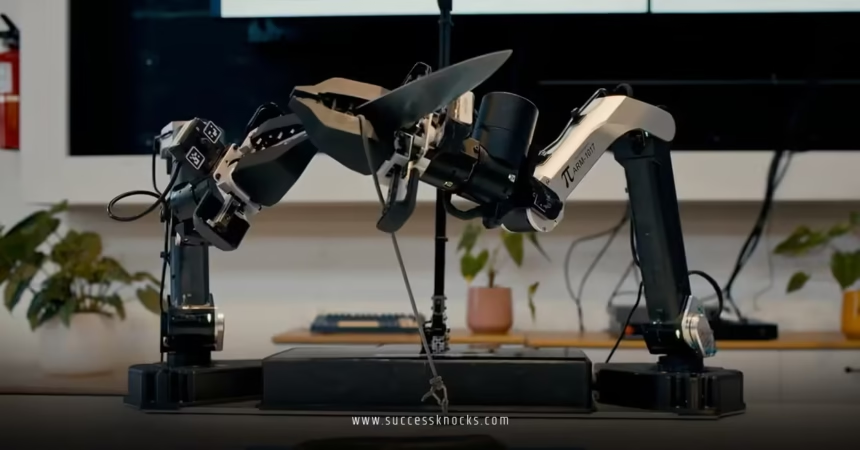
Physical Intelligence π0.7 compositional generalization zero-shot cross-embodiment is the mouthful that robotics engineers can’t stop talking about in 2026. Here’s the short version: it’s a single robot “brain” that can perform tasks it was never explicitly trained on, and it can jump between different robot bodies without needing to be retaught from scratch. That’s a genuinely big deal, and it’s not hype dressed up as science.
Quick answer, because your time matters:
- π0.7 is Physical Intelligence’s latest vision-language-action (VLA) foundation model, released April 16, 2026.
- Compositional generalization means it recombines learned skills (like “pour” plus “open door”) to solve brand-new tasks it never saw during training.
- Zero-shot cross-embodiment means the same model can control a robot arm it’s never touched — no fine-tuning required — and still perform close to expert-teleoperator level.
- It matches the performance of specialist, task-tuned models using one general-purpose system.
- This matters because it slashes the time and cost of deploying robots on new hardware or new jobs.
What Physical Intelligence π0.7 Actually Is
Let’s back up a second. Physical Intelligence (PI) is a San Francisco-based robotics research company chasing a single, audacious goal: a model that controls any robot to do any task, the way ChatGPT handles almost any text prompt [1].
π0.7 is their newest step toward that. It builds on the earlier π0 and π0.5 models but adds something those didn’t have: rich, multimodal “context conditioning.” Instead of just telling the robot what to do, you can now tell it how — through language coaching, metadata tags, or even a visual subgoal image.
Here’s the kicker. That extra context is what unlocks compositional generalization. The model isn’t memorizing fixed action sequences. It’s learning a vocabulary of skills it can shuffle and remix on the fly.
Why Compositional Generalization Is the Real Headline
Think of it like a chef who’s only ever cooked from recipe cards suddenly being able to improvise a new dish from ingredients they’ve never combined before. That’s roughly what’s happening inside π0.7.
Physical Intelligence’s own technical report describes the model loading a sweet potato into an air fryer — an appliance and action combo absent from its training data — purely by composing “pick up object” and “operate appliance” skills it already knew [2]. No laundry-folding data existed for a specific robot, yet the model folded a t-shirt on it anyway.
That’s compositional generalization in a nutshell: solving unseen problems by rearranging known building blocks. It’s a very different flavor of “smart” than pattern-matching a huge dataset.
Physical Intelligence π0.7 Compositional Generalization vs. Traditional Fine-Tuning
Traditional robot learning usually means: collect data on Task A, train a specialist model, repeat for Task B. π0.7 breaks that loop. One model, many tasks, minimal per-task data collection.
Does that mean specialist models are obsolete? Not quite — but their advantage is shrinking fast.
Zero-Shot Cross-Embodiment: The Part That Should Excite Beginners
If compositional generalization is about new tasks, zero-shot cross-embodiment is about new bodies. And this is where π0.7 gets genuinely wild.
PI tested the model on a bimanual UR5e industrial arm setup — a robot barely represented in its training mix. The arms differ in size, reach, and mechanics from PI’s usual hardware. π0.7 still folded shirts on it, on the first attempt, at a success rate close to human teleoperators attempting the same unfamiliar robot for the first time [2].
That comparison matters. The benchmark wasn’t “perfect robot performance.” It was “can the model match a skilled human doing something unfamiliar for the very first time?” And it basically did.
How Physical Intelligence π0.7 Zero-Shot Cross-Embodiment Numbers Stack Up
According to PI’s published report, human operators hit roughly 90.9% task progress and an 80.6% success rate on the unfamiliar robot. π0.7 landed at about 85.6% task progress and 80% success — essentially neck-and-neck [2].
| Metric | Human Operator (First Attempt) | π0.7 (Zero-Shot) |
|---|---|---|
| Task Progress | 90.9% | 85.6% |
| Success Rate | 80.6% | 80.0% |
| Robot Used | UR5e Bimanual (unfamiliar) | UR5e Bimanual (unfamiliar) |
| Prior Training on This Task/Robot | None | None |
| Success Rate on In-Distribution Tasks | — | 90%+ |
| Success Rate on Unseen Task/Robot Combos | — | 60%–80% |
Worth flagging honestly: PI’s own paper notes zero-shot performance still trails in-distribution performance. Unseen combinations land in the 60–80% range versus 90%+ for tasks the model has actually trained on [2]. Progress, not magic.
What Makes π0.7 Different From π0 and π0.5
I’ve followed this progression closely, and the architecture shift is subtle but important. π0 (October 2024) proved cross-embodiment training was viable at all — one model, eight distinct robots, shared skills [3]. π0.5 pushed that toward open-world household generalization, deploying in homes it had never seen.
π0.7 adds the piece those earlier versions lacked: a deliberate, diverse “prompting strategy.” Instead of one instruction format, the model trains on language descriptions, episode metadata, control labels, and subgoal images simultaneously. That variety, PI argues, is precisely what forces the model to generalize compositionally rather than memorize [1].
In my experience watching robotics ML mature, that’s the pattern that usually separates a lab demo from something deployable: not a bigger model, but richer, messier training signal.
Step-by-Step: How Beginners Should Approach π0.7-Style Models
If you’re new to VLA (vision-language-action) robotics and want to actually understand or experiment with this space, here’s the practical path I’d take.
- Start with the concept, not the code. Read PI’s public blog post on π0.7 before touching any repo — it explains the “why” in plain language [1].
- Get comfortable with VLA basics. Understand that these models take images, text instructions, and robot state as input, and output motor commands.
- Study the Open X-Embodiment dataset. It’s the widely-used, cross-institution dataset that underpins a lot of cross-embodiment research and is publicly documented on arXiv [4].
- Look at openpi if you want hands-on experimentation. PI has partially open-sourced earlier model weights for research use — a solid low-cost way to poke around.
- Track real success-rate numbers, not marketing language. Compare zero-shot vs. fine-tuned performance for any model you’re evaluating.
- Set expectations early. Zero-shot doesn’t mean perfect. Budget for the 60–80% success band on novel tasks, not the 90%+ in-distribution number.
Common Mistakes & How to Fix Them
Mistake: Assuming “zero-shot” means “flawless.”
Fix: Treat zero-shot cross-embodiment as “strong first attempt,” not production-ready reliability. Plan for human oversight during early deployment.
Mistake: Confusing compositional generalization with general intelligence.
Fix: π0.7 recombines learned skills — it isn’t reasoning from scratch like a human problem-solver. Keep the claims scoped to what’s demonstrated.
Mistake: Ignoring the role of prompt context.
Fix: PI’s results depend heavily on rich, varied prompting during training. If you’re building something similar, skimping on prompt diversity will tank your generalization gains.
Mistake: Comparing benchmarks across different robots without normalizing for difficulty.
Fix: Task difficulty and embodiment familiarity both swing success rates hard. Always check what the baseline comparison actually is — as PI did, comparing against first-attempt human teleoperators rather than an arbitrary number.
Key Takeaways
- Physical Intelligence π0.7 compositional generalization zero-shot cross-embodiment describes a single robot foundation model that generalizes across both new tasks and new robot hardware.
- Released April 16, 2026, π0.7 builds on π0 and π0.5 with richer multimodal prompting during training.
- Compositional generalization lets the model combine known skills to solve tasks it never explicitly trained on.
- Zero-shot cross-embodiment transfer let π0.7 match near-expert human performance on an unfamiliar robot with zero task-specific training.
- Performance still dips on unseen task-robot combos (60–80%) compared to trained tasks (90%+).
- This matters practically because it cuts the cost and time of deploying robots on new hardware.
- It’s not general intelligence — it’s skill recombination, and that distinction matters for realistic expectations.
The Bottom Line
Here’s the thing — robotics has spent a decade drowning in one-off, brittle, task-specific models. π0.7 is a real signal that the field is shifting toward general-purpose robot brains, the same way GPT-style models reshaped text and code. Is it finished? No. Is it a meaningful inflection point? I’d say yes, cautiously.
If you’re evaluating this space for a business case or a research direction, start by reading PI’s own technical writeup, benchmark it against your specific task complexity, and don’t assume zero-shot equals production-grade yet.
FAQs
Does Physical Intelligence π0.7 compositional generalization work without any fine-tuning at all?
Yes, for many demonstrated tasks — that’s the point of zero-shot cross-embodiment. But PI’s own data shows performance is lower (60–80%) on genuinely novel task-robot pairings compared to trained scenarios [2].
How is zero-shot cross-embodiment different from just training on more robots?
Training on more robots teaches a model patterns from robots it’s seen. Zero-shot cross-embodiment means the model performs on a robot it has essentially never trained on, relying on shared underlying representations rather than direct exposure.
Is π0.7 available for public use or only research demos?
Physical Intelligence has partially open-sourced earlier weights (π0/π0.5 family) for research use through their openpi repository; production access and licensing for the latest models are typically handled directly through the company.