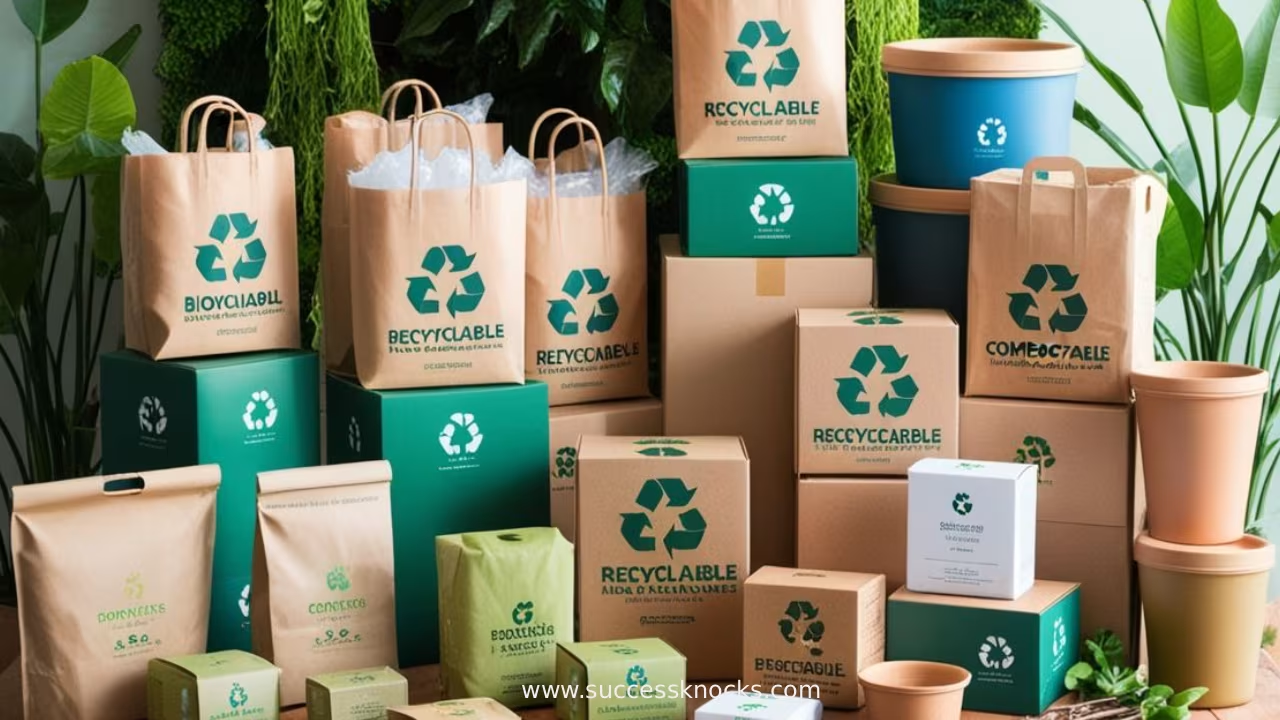
Which industries are adopting reusable packaging fastest right now in the USA? Food and beverage logistics, grocery retail, and e-commerce fulfillment lead the pack, with automotive still deep in mature systems and healthcare/pharma accelerating on temperature-controlled needs. Closed-loop venues and personal care are catching up fast under EPR pressure and cost realities.
Here’s the quick read:
- Food & beverage (especially fresh produce, dairy, and prepared foods) dominates volume through reusable plastic crates and totes.
- Grocery retail and e-commerce are scaling consumer-facing and shipper systems hardest in 2025–2026.
- Automotive keeps high conversion rates on returnable dunnage and containers.
- Healthcare shows some of the strongest growth rates for insulated and sterile reusables.
- Sports venues, school food service, and personal care/home care are moving from pilots to pilots-plus.
This matters because single-use packaging costs keep rising, state EPR laws are spreading, and the operational math now favors reuse once return rates clear a certain threshold. For the bigger picture on building an entire reusable packaging business around online retail, see the full guide on reusable packaging business for ecommerce.
Which industries are adopting reusable packaging fastest in food and grocery
Walk into any major U.S. grocery distribution center and you’ll see the shift. Reusable plastic containers (RPCs) from pooling operators like IFCO and Tosca have become standard for produce, meat, dairy, and bakery. Retailers including Walmart, Kroger, and Sysco run multi-temperature systems that cut spoilage, improve stacking density, and slash disposal fees.
The U.S. Plastics Pact’s Reuse in Retail Initiative is pushing this further. In its 2025–2026 scoping work with brands and retailers, prepared foods and fresh-cut produce emerged as priority categories for scalable return-on-the-go systems, with pilots targeting mid-2027. Personal care and home care bottles are next, aiming for 2028.
Which industries are adopting reusable packaging fastest What usually happens is the back-of-house operations adopt first because the loop is closed and controlled. Consumer-facing refill or return programs lag until the reverse logistics and wash infrastructure catch up. In my experience, the operators who win treat the crates as assets, not packaging expense.
E-commerce is the other high-velocity player. Online grocery and general merchandise shippers are testing durable totes, collapsible boxes, and returnable mailers. The volume is still smaller than B2B food logistics, but the growth rate is steeper because every box has a visible sustainability story attached to the brand.
Automotive and industrial still set the efficiency bar
Automotive did this decades ago. OEMs and Tier suppliers run massive fleets of custom returnable dunnage, totes, and racks for just-in-time parts. Conversion rates from single-use sit in the high 60s to low 70s percent range in mature networks. Payback often lands inside 14–18 months once the system stabilizes.
The same logic applies to other industrial and chemical flows using intermediate bulk containers and drums. These sectors already treat packaging as a circulating asset. The rest of the economy is simply catching up to what auto learned under cost and quality pressure.
Healthcare and pharma: quiet but rapid growth
Temperature-controlled shippers and sterile containers are expanding quickly. Specialty pharmaceuticals and biologics demand reliable cold-chain performance, and reusable insulated systems deliver it with lower long-term cost than disposable coolers. Market analyses consistently flag healthcare as one of the faster-growing end-use segments through the early 2030s.
The kicker is regulatory hygiene. Once a system is validated for cleaning and tracking, hospitals and distributors stick with it. New entrants face higher barriers, but the ones already in enjoy sticky demand.
Sports venues, schools, and closed-loop settings
Large-scale events and institutional food service offer the cleanest economics right now. High volume, captive audiences, and centralized washing make return rates far easier to control. Operators are locking multi-year contracts with stadiums and school districts because the infrastructure can later support nearby grocery or restaurant loops. Major 2026–2028 events are expected to normalize the experience for millions of attendees.
Personal care and home care sit in the middle. Refill stations and durable bottles are expanding, but open-loop consumer returns remain the hardest nut. Shared collection and standardized packaging designs are the only realistic path to scale, as the Ellen MacArthur Foundation has argued in its reuse research.
| Industry | Current Adoption Momentum | Primary Drivers | Typical Formats | Key Constraint |
|---|---|---|---|---|
| Food & Beverage / Grocery | Highest volume, strong growth | Waste reduction, cold chain, EPR | RPCs, totes, crates | Wash capacity & return logistics |
| E-commerce / Retail fulfillment | Fastest consumer-facing growth | Brand perception, shipping cost | Durable boxes, mailers, totes | Consumer return rates |
| Automotive / Industrial | Mature, high conversion | Cost, quality, JIT | Custom dunnage, racks, IBCs | Already optimized |
| Healthcare / Pharma | High CAGR | Cold chain, sterility, cost | Insulated shippers, sterile trays | Validation & tracking |
| Venues / Institutional | Rapid closed-loop scaling | Volume, control, contracts | Cups, trays, containers | Upfront wash infrastructure |
Step-by-step action plan for beginners looking at which industries are adopting reusable packaging fastest
If you’re evaluating entry or expansion, start practical.
- Map your own flows. List the SKUs or shipment types with the highest volume and most predictable return paths. Food and grocery shippers almost always win here first.
- Talk to existing poolers. Operators already running RPCs or pallets in your region know the real recovery rates and cleaning costs. Ask for their latest LCA numbers rather than marketing claims.
- Pilot one closed loop. Choose a single distribution lane or venue partner where you control both ends. Measure actual return rate, damage, and wash cost for 90 days.
- Model the break-even. Calculate cycles needed to beat single-use on total cost of ownership. Most solid systems clear it between 5 and 15 uses depending on material and distance.
- Layer policy. Check which states already have packaging EPR. Those markets reward reuse faster because the compliance math improves.
- Design for tracking. RFID or simple barcode systems prevent loss. Without it, shrinkage kills the ROI.
What I’d do if I were starting today: pick produce or prepared-food crates in an EPR state, partner with an established pooler, and keep the first system dead simple. Complexity kills early pilots.
Common mistakes & how to fix them
Underestimating reverse logistics. People focus on the shiny container and forget the empty miles and wash schedules. Fix: budget reverse costs at 30–40% of the forward trip until data proves otherwise. For deeper operational detail on returns, the logistics side is covered in reusable packaging logistics return and reuse systems explained.
Chasing open-loop consumer returns too early. Deposit systems and consumer education take years. Fix: master B2B or closed-loop first, then expand.
Ignoring standardization. Custom shapes look great on a pitch deck and die in shared wash lines. Fix: design to existing pool standards whenever possible.
Skipping hygiene validation in food or healthcare. One contamination scare ends the program. Fix: involve quality and regulatory teams from day one and document the cleaning protocol.
Treating reuse as a marketing add-on instead of an operations project. It fails. Fix: put supply-chain leadership in charge with clear cost and recovery KPIs.
Key Takeaways
- Food & beverage logistics and grocery retail currently move the most reusable packaging volume in the U.S.
- E-commerce and consumer-facing retail are adopting fastest on the growth curve.
- Automotive remains the efficiency benchmark with high conversion rates.
- Healthcare and closed-loop venues (stadiums, schools) show strong acceleration.
- EPR laws and rising single-use costs are the real accelerators in 2026.
- Closed loops beat open loops on economics until shared infrastructure matures.
- Tracking, standardization, and wash capacity decide whether a system scales or stalls.
- Start with high-volume, controllable flows and measure real return rates before expanding.
The industries winning at reusable packaging treat containers as circulating assets rather than disposable cost centers. That mindset shift, paired with the right partner network and realistic return math, turns sustainability from a compliance checkbox into a durable cost advantage. Pick one high-volume flow, run a tight pilot, and let the numbers decide the next step.
FAQs
Which industries are adopting reusable packaging fastest in the United States right now?
Food and beverage distribution (especially fresh produce and dairy via RPCs), grocery retail, and e-commerce fulfillment currently lead both volume and growth momentum, followed closely by healthcare cold-chain applications and closed-loop venues.
Why is food and beverage ahead of other sectors on reusable packaging?
High shipment frequency, strict hygiene needs that favor cleanable rigid containers, and existing pooling infrastructure from operators serving major retailers make the economics work sooner than in more fragmented categories.
How do regulations affect which industries are adopting reusable packaging fastest?
State-level packaging EPR programs increase the cost of single-use options, so industries already operating high-volume, controllable supply chains (grocery, foodservice, industrial) can capture savings faster while others wait for shared collection systems to mature.